11.26.2010
Japanese Language Tools
11.16.2010
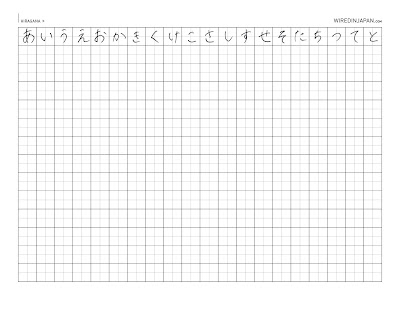
Wired Kana - Blank Japanese Practice Sheets

Download the
Blank Japanese practice sheets (49kb pdf)
A great way to test your ability to recall Hiragana and Katakana from memory, is to try writing the characters without any images for reference. If you're able to completely write the alphabets by hand, you'll be able to read them when you come across Hiragana or Katakana in Japanese writing.
Try using this blank Japanese practice sheet to test your memory. It's best to write out all of characters in order and when you come to a character that you can't remember, skip it and move on to the next one. When you finish the entire alphabet, you can see which characters you systematically forget.
It has been a long time since I've needed to practice Hiragana and Katakana. I've done so many of these sheets that there is no way I'll ever forget these characters. To read about my earlier experiences while learning Hiragana and Katakana, take a look at this old post: Think you know your Kana?
Download the
Blank Japanese practice sheets (49kb pdf)
If your not at this level yet, be sure to use these Hiragana and Katakana practice sheets. Or, if you think Kana are too basic, try Wired Kanji lesson 1.
11.10.2010
Wired Kana - Hiragana and Katakana Practice Sheets

Learning Hiragana and Katakana, the Japanese alphabets, really helped me while navigating Japan and now that I'm trying to learn to read Japanese, they're helping me to understand Kanji. The sooner I was able to stop using romaji, and switch to writing Japanese in Hiragana and Katakana, the more Japanese I was able to understand and read.
To practice Hiragana and Katakana, my Japanese tutor, Rio Sensei, suggested I use practice sheets and write the characters over and over again. After all that practice, there's no way I'll ever forget a character.
Download:
Hiragana and Katakana Practice Sheets
(300kb PDF)
Or get them on the Wired in Japan Flickr.
The handwriting was generously drafted by a native hand, good friend and graphic designer, Yuka Nishino.
9.18.2009
Asking "how to say" in Japanese

Today in Japanese class our sensei introduced us to a handy phrase, giving us the ability to ask how to say something, that we don't already know, in Japanese.
__ は にほんご で なん と いいます か。
__ wa nihongo de nan to iimasu ka?
How do I say __ in Japanese?
Q:
Glassesはにほんごでなんといいますか。
Glasses wa nihongo de nan to iimasu ka?
How do you say Glasses in Japanese?
A:
めがねいいます。
megane iimasu.
You say megane.
This phrase is handy, especially when talking to a teacher, because they are able to take your english request and parse it into Japanese.
When in Japan, I know I will be using this phrase all the time, but my Japanese host family probably wont understand English. Thus this helpful modification is appropriate:
Q:
これはにほんごでなんといいますか。
kore wa nihongo de nan to iimasu ka?
What is this called in Japanese?
A:
それはほんです。
sore wa hon desu.
That's a book.
The next time you're not sure how to say a word in Japanese, don't be afraid to ask. Just us this valuable phrase.
9.08.2009
Elementary Japanese 101

Tomorrow marks the first day of my institutionally structured journey to better understand the Japanese language. I will be taking Elementary Japanese 101 at a local liberal arts college, in addition to my current education at design school. The course is a requirement in order to study abroad, yet one that I am looking forward to.
We will be using the Nakama Japanese textbook and workbook. Together, they were over $100 used at the bookstore. Hello Amazon.
In my self guided study, as well as working with my Japanese tutor, we worked with the Genki textbook. Genki was accessible and tried to make learning the language fun, overall a good textbook. Solely judging by the cover of Nakama, it looks strictly business. Hopefully as we progress, it will open up a bit.
Looking forward to meeting my fellow classmates and studying hard.
As usual, がんばります!(I'll do my best!)
8.10.2009
Think You Know Your Kana?
While learning the Japanese Language, I've often been asked if I know hiragana and katakana; It is a good way to measure a beginner Japanese learner's skill level. I would always answer that I knew my kana well; I knew the phonetic sounds and how to write Japanese characters on my computer.
Yet when I was asked by my Japanese tutor, Rio Sensei, who is thankfully very specific in regards to learning the Japanese language, I thought, no problem. Yet, there's a twist: write them out, by hand, without any reference. Fail. I knew how to write some of the characters, but many I simply drew a mental blank.
Thus, Rio provided me a handy sheet for practicing hiragana and katakana. Over my time learning Japanese, I've completed over 80 sheets of kana practice. That's approximately 12,300 individually written kana; does your arm hurt after that. This is over a time span of about five months now.
That said, there are a few pesky kana, particularly katakana, that I blank on. While the previous kana worksheets are great for learning form and order, I have devised a new work sheet to help with memorization; unaided recall.
This new sheet has no sample kana to sample from; it is just you and your memory. I like to stream through all the hiragana then katakana, in proper order, then start again on the next line. If I blank, I leave a space and move on. It's good for keeping track of the characters you forget.
Get the blank practice sheet here
Now I know that I frequently forget: め(me), も(mo) in hiragana and ヌ(nu), ネ(ne), メ(me), モ(mo), ル(ru), レ(re) in katakana.
What hiragana and katakana do you seem to always forget?
8.09.2009
My Japanese Coach Review.
Many people seem to be using the Nintendo DS video game My Japanese Coach to learn the Japanese language, so I thought I would give it a play.
I have been learning Japanese, self studying, for some time now. Thus in the placement test, I tested into lesson five.
The placement test gives you a series of, at the most, 50 some questions. If you get two incorrect answers in a row, the test ends and you get placed in the appropriate lesson. The part that I fumbled up on was the days of the week. I should know them by know, so I am glad that’s where I’m starting out. The days of the week are an important thing to know.
The video game My Japanese Coach is a great resource as an introduction to the Japanese Language. It is fun and easy to get into. It starts you out with English spellings of Japanese words (romaji) and as you progress becomes written with Japanese characters (hiragana, katakana, kanji).
My only qualm is about the necessity of romaji for continued learning. It serves its role in making this game accessible, but is a crutch in the long run; if your learning a foreign language, you should use the proper characters. Thus, my word of advice: learn hiragana and katakana as soon as possible and get away from romaji just as quick.
Overall a fun game. がんばって! (Do your best!)
7.30.2009
Wired in Japan: Icon
![]()
The generosity of olliecapehorn (from the Japanese language site, JapanesePortal), was an impetus in the creation of an icon for the Wired in Japan blog.
I designed this mark to evoke the symbology of the Japanese flag;
an immediately recognizable icon in itself. It also plays off the idea of being wired, or connected. There are also formal similarities in the iconography for RSS, broadcasts, transmission, and a worldwide wholeness or globality.
As you will undoubtedly notice, the icon is composed from the Japanese character の (no), which is a particle that "indicates ownership or attribution." The use of a Japanese character was important to denote the focus on learning the Japanese language.
Also, to me, it is representative of my personal experiences,
thus my individual journey to learn about Japan.
6.27.2009
Graphic Design Terminology
For all you Smart.fm users, I created a list on graphic design terms in Japanese. These terms a very helpful when searching for Japanese design. One can get a good view about what is happening in Japanese design by googling in the native language.
The list encompasses basics like:
グラフィックデザイン - Graphic Design
フォント - Font
ロゴ - Logo
ポスター - Poster
To more esoteric terms like:
バウハウス - Bauhaus
ポール・ランド - Paul Rand
スイス・スタイル - Swiss Style
ヘルヴェチカ - Helvetica
ビジュアルコミュニケーション - Visual Communication
All the words are in katakana, because they're loan words or foreign names. Basically sound out the English word with Japanese pronunciation.
がんばって!
6.09.2009
Practice Writing Hiragana and Katakana

Rio-sensi, from the beginning, has put much emphasis on writing hiragana and katakana. To practice, I've been using writing sheets, which are composed of an array of boxes, each with a four cell grid, notating every basic kana. Thus, mimicking the initial example kana, the repetition and tactile experience has made profound development in my ability to understand written Japanese, in addition to the ability to breakdown vocabulary for proper pronunciation.
Update:
I recently revised the Hiragana and Katakana practice sheets to make them more efficient. View the new practice sheets here.
4.26.2009
tofu vs natto. とうふ vs なっとう.

こんにちはりおせんせい。
わたしはとうふがすきです。なっとうはすきじゃありません。
あなたはすきですか。
From a message I hand wrote to my teacher:
Hello Rio sensei.
Tofu is my favorite. Natto is not my favorite.
(I've never actually tried it, but i hear it is quite peculiar.)
What is your favorite?
3.29.2009
Remember the Kanji - Lesson 1
I completed Lesson 1 of Heisig’s Remember the Kanji. It was super easy and a quick lesson. I used the list on smart.fm to study my way through.
There was only 15 items to learn which included the numbers 1-10 in addition to the words moon, mouth, day, rice field, and eye. The kanji for the numbers is quite beneficial. I also noticed that the nouns in this lesson were built on similar shapes and sounds.
一 – いち – i.chi – 1
二 – に – ni – 2
三 – さん – sa.n – 3
四 – し – shi – 4
五 – ご – go – 5
六 – ろく – ro.ku – 6
七 – しち – shi.chi – 7
八 – はち – ha.chi – 8
九 – きゅう – kyu.u – 9
十 – じゅう – jyu.u – 10
口 – くち – ku.chi – mouth
日 – にち – ni.chi – day
月 – つき – tsu.ki – moon
田 – た – ta – rice field
目 – め – me – eye
I’m really starting to like Kanji. It’s not nearly as scary as I first thought. I’m picking them up real quickly because I’m dominantly a visual learner. That way I can develop visual cues which help me relate words and meanings. This process makes remembering the Kanji a snap.
3.23.2009
Rosetta Stone Lesson 1 Complete!
I just started using Rosetta Stone to supplement my self directed Japanese language study. Today I completed Lesson 1 of unit 1 from the course Japanese 1.
Rosetta Stone was much more than I expected. It creates a good balance between each of the necessary language skills: speaking, reading, writing, pronunciation, grammar.
My personal favorite sections are speaking. Rosetta Stone utilizes the built in microphone in my macbook and uses voice detection and audio analysis to gauge the correctness of your pronunciation. The feature is spot on and it really helps because spoken Japanese is my weakest language area.
The vocabulary was a good selection of basic words and phrases. Hello (こんにちは), goodbye (さようなら), girl(女の子), boy(男の子), man(男の人), woman(女の人). Also with phrases like “the boys are reading books” (男の子たちは本を読んでいます).
There were two instances where I continually had difficulties pronouncing words. the “hito” in “otokonohito” (おとこのひと – man) and the word “ryouri” (りょうり – to cook) used to trip me up quite a bit. Through pronunciation practice I have a much better handle.
It is also worth mentioning the ability to learn characters in kanji with furigana (kanji with small hiragana above to show pronunciation). It surprises me but I am starting to understand pairings of kana as words in themselves rather than translating them into romaji in my mind. Eventually I will see the kana for 男の子 and know that it means boy.
On to lesson two!
3.18.2009
Do your best! Ganbatte! がんばって!

Ganbatte - Do your best! Ganbatte - Good luck!
One word that fascinates me to no end is the word ganbatte (sometimes written gambatte). It is a saying used to encourage people to try hard or used before a performance to say good luck. Ian Thomas Ash has an excellent write up on the various conjugations of the word ganbatte. It starts to get pretty complex, but think about all the ways you can encourage people to do their best!
Don't forget to support our friends in Japan!
頑張って (がんばって)The word ganbatte stems from the verb ganbaru:
Ganbatte: Do your best
頑張る (がんばる)Here are some other ways to use this handy verb:
Ganbaru: To do one's best
頑張ります (がんばります)
Ganbarimasu: I do my best
頑張れ (がんばれ)
Ganbare: Do your best
頑張ってください (がんばってください)
Ganbatte Kudasai: Do your best, please. (formal)
頑張った (がんばった)
Ganbatta: I did my best
頑張りました (がんばりました)
Ganbarimashita: I did my best (formal)
頑張れます (がんばれます)
Ganbaremasu: I can do my best
頑張れる (がんばられる)
Ganbareru: I am able to do my best
頑張っています (がんばっています)
Ganbatteimasu: I am doing my best
頑張りたい (がんばりたい)
Ganbaritai: I want to do my best
頑張っていた (がんばっていた)
Ganbatteita: I was doing my best
頑張らなかった (がんばらなかった)
Ganbaranakatta: I did not do my best
頑張りなさい (がんばりなさい)
Ganbarinasai: you had better do your best
頑張ってくれ (がんばってくれ)
Ganbatekure: do your best for me
One instance where I find ganbaru useful is when I'm talking about my understanding of the Japanese language. I'll say, "私は日本語がちょっと分かります、でもがんばります!" (Watashi wa Nihongo ga chotto wakarimasu, demo ganbarimasu!). Which means, "I understand a little Japanese, but I do my best!".
Do your best!
3.16.2009
smart.fm - 3.16.2009
Today I studied these terms:
優しい – やさしい – ya.sa.shi.i. (yah-sa-she) – gentle, kindhearted
易しい – やさしい – ya.sa.shi.i (ya-sa-she) – easy, simple
意地悪な – いじわるな – i.ji.wa.ru.na (ee-gee-wah-lou-na) – mean
嫌い – きらい – ki.ra.i (key-rah-ee) – dislike
正直 – しょうじき – sho.u.ji.ki (show-gee-key) – honest, upright
Two words with the same sound yet different meanings! やさしい(Yasashii) means both kindheartedness as well as being easy or simple.
I envision the kanji, 優, like a large and ornate monster that is scary at first but is actually really kind and benevolent.
The other kanji, 易, is much simpler in composition and, to me, looks like a helping hand, making everything easier by working together.
Friend me on smart.fm, lets learn together.
3.11.2009
smart.fm - 3.11.2009
Today, using smart.fm, I studied these terms:
悪い – わるい – wa.ru.i (wah-louie) – bad
良い – いい – i.i (ee) – good
意地悪な – いじわるな – i.ji.wa.ru.na (ee-gee-wah-lou-na) – mean
嫌い – きらい – ki.ra.i (key-rah-ee) – dislike
賑やか – にぎやか – ne.gi.ya.ka (knee-gee-yah-ka) – lively, exciting
The the kanji for 意地悪な – igiwaruna (mean), is just plain mean looking; three complex looking kanji in a row. Notice how the kanji for bad is also in the word mean, 悪. It looks like a mean person sticking their tongue out at you.
Friend me on smart.fm, lets learn together.
3.01.2009
Ryan the Wired on 43Things

I've spent a lot of time on 43Things (a community site for achieving your goals and writing about your journey). My main goal is to Learn japanese so that I can best study in Osaka, Japan next year.
Give 43Things a try, connect with me and lets do our best!
2.21.2009
In the City.

new vocabulary:
病院 - びょういん - byo.u.i.n (bi-yo-ein) - hospital
交番 - こうばん - ko.u.ba.n (koh-bon) - police station
郵便局 - ゆうびんきょく - yu.u.bi.n.kyo.ku (you-bean-key-oh-ku) - post office
銀行 - ぎんこう - gi.n.ko.u (geen-ko) - bank
スーパーマーケット - su.pa.ma.ke.tto. (su-pah-mah-ket-toe) - supermarket
店 - みせ - mi.se (me-say) - shop
図書館 - としょかん - to.sho.ka.n (toe-show-kahn) - library
薬局 - やっきょく - ya.kkyo.ku (yah-key-oh-ku) - pharmacy
パン屋 - ぱんや - pa.n.ya (pon-yah) - bakery
映画館 - えいがかん - e.i.ga.ka.n (eh-gah-kahn) - cinema
library is my 好き (favorite) word. partly because i love libraries and reading books but also because how pictographic the kanji for it is. the middle character just looks like a big stack of books, how easy to remember.
japanesepod101 - from the lesson video vocab - in the city
What's Your Name?

new vocabulary
名前 - なまえ - na.ma.e (na-my) - name
new phrases:
kanji: 私の名前はライアンです。
hiragana: わたしのなまえはライアンです。
romaji: watashi no namae wa raian (Ryan) desu.
english: my name is Ryan.
kanji: 貴方の名前は何ですか?
hiragana: あなたのなまえはなんですか?
romaji: anata no namae wa nan desu ka?
english: what is your name?
----------
みなさんこんにちは。
わたしのなまえはライアンです。
あなたのなまえはなんですか?
----------
hello everyone.
my name is ryan.
what is your name
from one minute japanese - lesson 6 - what's your name?
2.16.2009
What's your hobby?

A new phrase today. One that will help me get to know people and experience new things.
あなたのしゅみはなんですか?
anata no shumi wa nan desu ka?
What's your hobby?
グラフィックデザインです。
gurafikku dezain desu.
Graphic Design.
or in a complete sentence:
わたしのしゅみはグラフィックデザインです。
watashi no shumi wa gurafikku dezain desu.
My hobby is Graphic Design.
I wouldn't call it a hobby exactly. It is more like a passion. It is really all I do, all day. I go to school and design, I write essays about design, I read about design, and if I have time left over I do design for fun. I am also learning japanese so that I can practice design in japan.
----------
あなたのしゅみはなんですか?
わたしのしゅみはグラフィックデザインです。
わたしはまいにちけんきゅうしている。
----------
What is your hobby?
My hobby is graphic design.
I practice everyday.
from Talk Sushi - Japanese Phrases - Hobbies.