Showing posts with label hear japanese. Show all posts

5.14.2012

Erin's Challenge! Japanese Video Lessons


A few years ago, Japan Society produced a televised video series called Erin's Challenge! I Can Speak Japanese. In the show, you follow an exchange student as she moves to a new school, learning Japanese as she goes.

I first found out about Erin's Challenge on YouTube (aka Erin ga Chosen! Nihongo Dekimasu or エリンが挑戦!にほんごできます in Japanese). It was an interesting show and it helped me pick up some useful conversational vocabulary. Now they've taken it one step further and developed an interactive website to go along with it.

The website allows you to watch all of the episodes for free, providing subtitles, transcripts, audio samples, a manga version, review questions, and everything else you might get from a textbook or language course.

As you watch the video, it displays text-based subtitles, giving you a whole number of options; the native Japanese with kanji, hiragana, or romaji, as well as the translation in English, Spanish, Portuguese, Chinese, and Korean. You can turn on and off each of the options, giving you a lot of flexibility. You can even set it to automatically pause after each sentence, letting you study every word in detail.

Overall, it's a great Japanese learning resource with a ton of features and a lot of content, making it a fun and intuitive way to learn Japanese.

Check it out, here.

3.03.2010

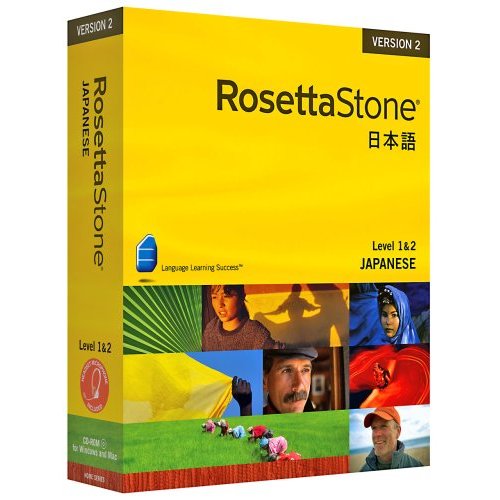
Rosetta Stone: Japanese Speaking Lesson


I'm currently using Rosetta Stone as a tool to learn Japanese. The weakest element of my Japanese language skill is speaking it. Thus, the speaking lessons included in Rosetta Stone is quite helpful and fun, albeit a little strange to practice in public. Here's an example of me practicing Japanese with Rosetta Stone's speaking lesson.


As you can see in the video, the lesson goes through basic words, handy phrases, as well as constructing your own sentences. It will first tell you how to say it in Japanese while showing you a relevant photo and writing it out in Japanese text (I have mine set to Japanese with Kanji and Furigana to help me read them). Then it allows you to give your best shot at speaking in Japanese. If you make a mistake, it will show you where, and allow you to say it again until you get it right. Finally it will say the phrase in Japanese one more time and then you're on the way to learning Japanese.

Even though I sometimes trip-up and make some mistakes (you can't drink a book), it's good to start thinking in Japanese and speaking as much as possible.

2.24.2010

Japanese Youtube Collection


I've been collecting Youtube videos that are either in Japanese or about Japan in some way. As it turns out, I've reached the limit for favorite videos; a total of 660 videos. Thus I've decided to clean them up, remove the dead videos, and sort them into playlists.

Watch all the Japanese videos on my Youtube Channel.

It's a great way to practice your listening comprehension skills. It's helpful because you get to hear native speakers talking at full speed. Although, I can't say I understand much of it yet.

Some videos have subtitles, some don't, but I have found that if you give a video without subtitles a chance, there's a lot you can learn, even though you might not understand every word. The next time you run across a video in Japanese without subtitles, take a minute to watch the speakers expressions, mannerisms, and body language. You'll be amazed at how much you really know.

9.08.2009

Elementary Japanese 101


Tomorrow marks the first day of my institutionally structured journey to better understand the Japanese language. I will be taking Elementary Japanese 101 at a local liberal arts college, in addition to my current education at design school. The course is a requirement in order to study abroad, yet one that I am looking forward to.

We will be using the Nakama Japanese textbook and workbook. Together, they were over $100 used at the bookstore. Hello Amazon.

In my self guided study, as well as working with my Japanese tutor, we worked with the Genki textbook. Genki was accessible and tried to make learning the language fun, overall a good textbook. Solely judging by the cover of Nakama, it looks strictly business. Hopefully as we progress, it will open up a bit.

Looking forward to meeting my fellow classmates and studying hard.

As usual, がんばります!(I'll do my best!)

8.09.2009

My Japanese Coach Review.

Many people seem to be using the Nintendo DS video game My Japanese Coach to learn the Japanese language, so I thought I would give it a play.

I have been learning Japanese, self studying, for some time now. Thus in the placement test, I tested into lesson five.

The placement test gives you a series of, at the most, 50 some questions. If you get two incorrect answers in a row, the test ends and you get placed in the appropriate lesson. The part that I fumbled up on was the days of the week. I should know them by know, so I am glad that’s where I’m starting out. The days of the week are an important thing to know.

The video game My Japanese Coach is a great resource as an introduction to the Japanese Language. It is fun and easy to get into. It starts you out with English spellings of Japanese words (romaji) and as you progress becomes written with Japanese characters (hiragana, katakana, kanji).

My only qualm is about the necessity of romaji for continued learning. It serves its role in making this game accessible, but is a crutch in the long run; if your learning a foreign language, you should use the proper characters. Thus, my word of advice: learn hiragana and katakana as soon as possible and get away from romaji just as quick.

Overall a fun game. がんばって! (Do your best!)

6.07.2009

Practice Japanese With Pankun

パンくん (Pankun), the genius chimpanzee, is the star of a Japanese television show. Pankun is a chimp that's able to complete everyday tasks and is one comedic character.

In this episode watch Pankun face off with Aiba, a Japanese entertainer, in a contest of feats. They battle in various physical activities, such as: push ups, an eating contest, and a dance off.


To make learning Japanese a bit more interesting, I find it enjoyable to watch videos in which Japanese is the only spoken language, without any English subtitles. Watching videos without subtitles seems daunting at first, yet one is able to gain at least a fragment of understanding, even without completely understanding what they are saying.

If you simply watch the way people use body language, as well as listen to the emphasis and emotion that is put into the way they speak, it is easy to get the gist of what is going on.

I don't see watching video in Japanese as a way to learn the Japanese language, but rather a fun way to see how your listening comprehension is. After learning Japanese for a little while, I am able to progressively pick out words and phrases. The more that Japanese I learn, the more I will be able to understand.

3.23.2009

Rosetta Stone Lesson 1 Complete!

I just started using Rosetta Stone to supplement my self directed Japanese language study. Today I completed Lesson 1 of unit 1 from the course Japanese 1.

Rosetta Stone was much more than I expected. It creates a good balance between each of the necessary language skills: speaking, reading, writing, pronunciation, grammar.

My personal favorite sections are speaking. Rosetta Stone utilizes the built in microphone in my macbook and uses voice detection and audio analysis to gauge the correctness of your pronunciation. The feature is spot on and it really helps because spoken Japanese is my weakest language area.

The vocabulary was a good selection of basic words and phrases. Hello (こんにちは), goodbye (さようなら), girl(女の子), boy(男の子), man(男の人), woman(女の人). Also with phrases like “the boys are reading books” (男の子たちは本を読んでいます).

There were two instances where I continually had difficulties pronouncing words. the “hito” in “otokonohito” (おとこのひと – man) and the word “ryouri” (りょうり – to cook) used to trip me up quite a bit. Through pronunciation practice I have a much better handle.

It is also worth mentioning the ability to learn characters in kanji with furigana (kanji with small hiragana above to show pronunciation). It surprises me but I am starting to understand pairings of kana as words in themselves rather than translating them into romaji in my mind. Eventually I will see the kana for 男の子 and know that it means boy.

On to lesson two!

3.15.2009

National Geographic in Japanese: Learning x2.

National Geographic has a youtube page with all of its videos narrated in Japanese. Not only will it help you practice your Japanese listening skills but it could also teach you a thing or two.

It is also nice to know that the dialogue your listening to comes from a reliable source that is academic in nature, yet accessible to the general public. Maybe you’ll end up speaking Japanese like a documentary narrator; sounds like something to aspire to.